
Taking care of a baby is a beautiful experience, but it also brings many new responsibilities. From feeding and diaper changes to bathing, sleeping routines, and everyday hygiene, newborns and young babies need regular attention throughout the day and night.
For new parents, managing these responsibilities while balancing work, household tasks, and personal commitments can sometimes feel challenging. First-time parents may also need time to become confident with everyday baby-care routines.
This is where professional baby care services at home can help.
Home-based baby care services provide families with practical support from caregivers who assist with agreed baby-care responsibilities in the comfort of their homes. Depending on the caregiver’s experience and the family’s requirements, support may include feeding assistance, diaper changes, hygiene, soothing, and maintaining the baby’s daily routine.
At BornCares, we understand that every family has different needs. Our aim is to help parents explore suitable childcare and newborn-care support so they can feel more confident while caring for their little ones.
In this guide, we will explain what baby care services at home include, what professional caregivers can help with, their benefits, and how to choose the right support for your family.
1. What Are Baby Care Services at Home?
Baby care services at home involve arranging a caregiver to assist parents with everyday baby-care responsibilities in their own home.
Instead of taking the baby to an outside childcare facility, families can arrange support in a familiar home environment.
The caregiver’s responsibilities depend on the baby’s age, the family’s needs, the caregiver’s experience, and the agreed working hours.
Common services may include:
- Routine baby care and hygiene.
- Diaper changing and clothing changes.
- Feeding-related assistance.
- Burping and gentle soothing.
- Following the baby’s sleep routine and safe-sleep practices.
- Organizing baby-care essentials.
- Washing or arranging baby clothes, if agreed.
- Sharing updates about the baby’s daily routine.
Some families need support for a newborn, while others require assistance with an older infant or young child.
It is important to discuss the exact duties before hiring a caregiver. Not every baby-care service includes the same responsibilities or level of training.
2. Why Do Parents Need Baby Care Services at Home?
Every family has different reasons for arranging baby-care support. Some parents are returning to work, while others need help managing daily responsibilities.
Here are some common situations when home-based baby care may be helpful.
A. First-time parents need practical support
Caring for a newborn can feel unfamiliar at first. Parents may have questions about feeding, diaper changes, bathing, sleeping, and comforting their baby.
A caregiver with relevant experience can assist with routine tasks and demonstrate appropriate everyday care practices.
Parents should remain involved in decisions about their baby’s care and ask questions whenever they are unsure.
B. Working parents need assistance
Returning to work after welcoming a baby can be challenging. Parents may need someone to help with the baby’s daily routine while they are working.
A home-based caregiver can provide agreed support during working hours and communicate important updates to parents.
C. Parents need help managing daily routines
Babies need frequent attention. Feeding, changing, cleaning, soothing, and organizing baby-care supplies can take considerable time.
Additional support can help parents manage these responsibilities more comfortably.
D. Families have limited support at home
Some families live away from relatives or do not have family members available to assist after childbirth.
A suitable caregiver can provide practical help during agreed hours and make everyday baby-care responsibilities easier to manage.
E. Parents need support with multiple responsibilities
Families may also have older children, work commitments, or household responsibilities. Additional baby-care assistance can help parents organize their time.
3. What Can Professional Baby Caregivers Help With?
A professional caregiver may assist with several everyday baby-care activities, depending on their experience and the agreed service arrangement.
A. Feeding assistance
Feeding is one of the most important parts of a baby’s daily routine.
A caregiver may help by:
- Preparing a comfortable feeding area.
- Bringing the baby to the breastfeeding parent.
- Supporting bottle-feeding according to parental instructions.
- Helping with burping when appropriate.
- Cleaning feeding equipment according to hygiene instructions.
- Communicating feeding-related observations to parents.
Caregivers should follow the baby’s established feeding plan and should not independently change feeding amounts, formula, or schedules.
For breastfeeding difficulties, concerns about milk supply, or feeding problems, parents should consult a qualified lactation professional or healthcare provider.
B. Diaper changing and hygiene
Babies require frequent diaper changes to remain clean and comfortable.
A caregiver may help with:
- Checking and changing diapers.
- Cleaning the baby gently.
- Applying parent-approved diaper-care products.
- Dressing the baby in clean clothes.
- Keeping the changing area organized.
- Washing hands before and after diaper changes.
Good hygiene practices help maintain a clean baby-care environment.
C. Bathing and personal care
Bathing and cleaning a baby require gentle handling and attention.
Depending on the baby’s age and the caregiver’s experience, agreed support may include:
- Preparing bathing essentials.
- Helping parents with bathing routines.
- Cleaning the baby’s skin gently.
- Drying and dressing the baby.
- Keeping towels and baby-care items organized.
Newborns do not need frequent full baths. Parents should follow healthcare guidance about bathing frequency, cord care, and skin products.
D. Burping and soothing
Babies may need help settling after feeding or when they feel uncomfortable.
A caregiver may assist with gentle burping techniques and age-appropriate soothing methods.
These may include holding the baby safely, gentle rocking, or speaking softly.
A baby who cries unusually, seems unwell, or is difficult to settle should be brought to the parents’ attention.
E. Following the baby’s sleep routine
Sleep is an important part of infant development. However, babies have changing sleep patterns, and newborns often wake frequently.
A caregiver may help parents follow an agreed routine and prepare a safe sleeping environment.
Important safe-sleep practices include:
- Placing the baby on their back for every sleep.
- Using a firm, flat, separate infant sleep surface.
- Keeping pillows, loose blankets, and soft toys out of the sleeping area.
- Avoiding overheating.
- Following the parents’ and healthcare professional’s instructions.
A caregiver should never use unsafe sleep practices to make a baby sleep longer.
F. Organizing baby-care essentials
Keeping baby-care supplies organized can make daily routines easier.
Depending on the agreement, a caregiver may help organize:
- Diapers and wipes.
- Baby clothes.
- Towels and washcloths.
- Feeding supplies.
- Baby skincare products.
- Bedding and other baby essentials.
This helps parents find necessary items when they need them.
G. Maintaining a clean baby-care area
Some baby-care arrangements include simple cleaning and organizing tasks related to the baby.
These may include keeping the changing area tidy, organizing baby clothes, and cleaning agreed baby-care items.
General house cleaning, cooking, and other household duties should be discussed separately rather than assumed to be included.
4. Different Types of Baby Care Services Available at Home
Families may require different types of support depending on their baby’s age and daily routine.
A. Newborn care services
Newborn care focuses on supporting babies during their first few weeks and months.
Responsibilities may include:
- Routine diaper changes.
- Feeding-related assistance.
- Burping and soothing.
- Gentle hygiene.
- Following safe-sleep practices.
- Communicating daily observations to parents.
Newborns who were born prematurely or have medical needs may require specialized support arranged with their healthcare team.
B. Babysitter services
Babysitter services may suit families who need temporary or occasional childcare support.
A babysitter may help supervise a baby or young child during agreed hours, depending on their experience and the child’s age.
Parents should confirm that the babysitter has the skills and experience needed for the child’s particular age and requirements.
C. Nanny services
Nanny services generally provide more regular childcare support.
A nanny may assist with daily routines, age-appropriate activities, meals or snacks for older babies and children, and supervision.
The exact duties depend on the child’s age and the family’s agreement.
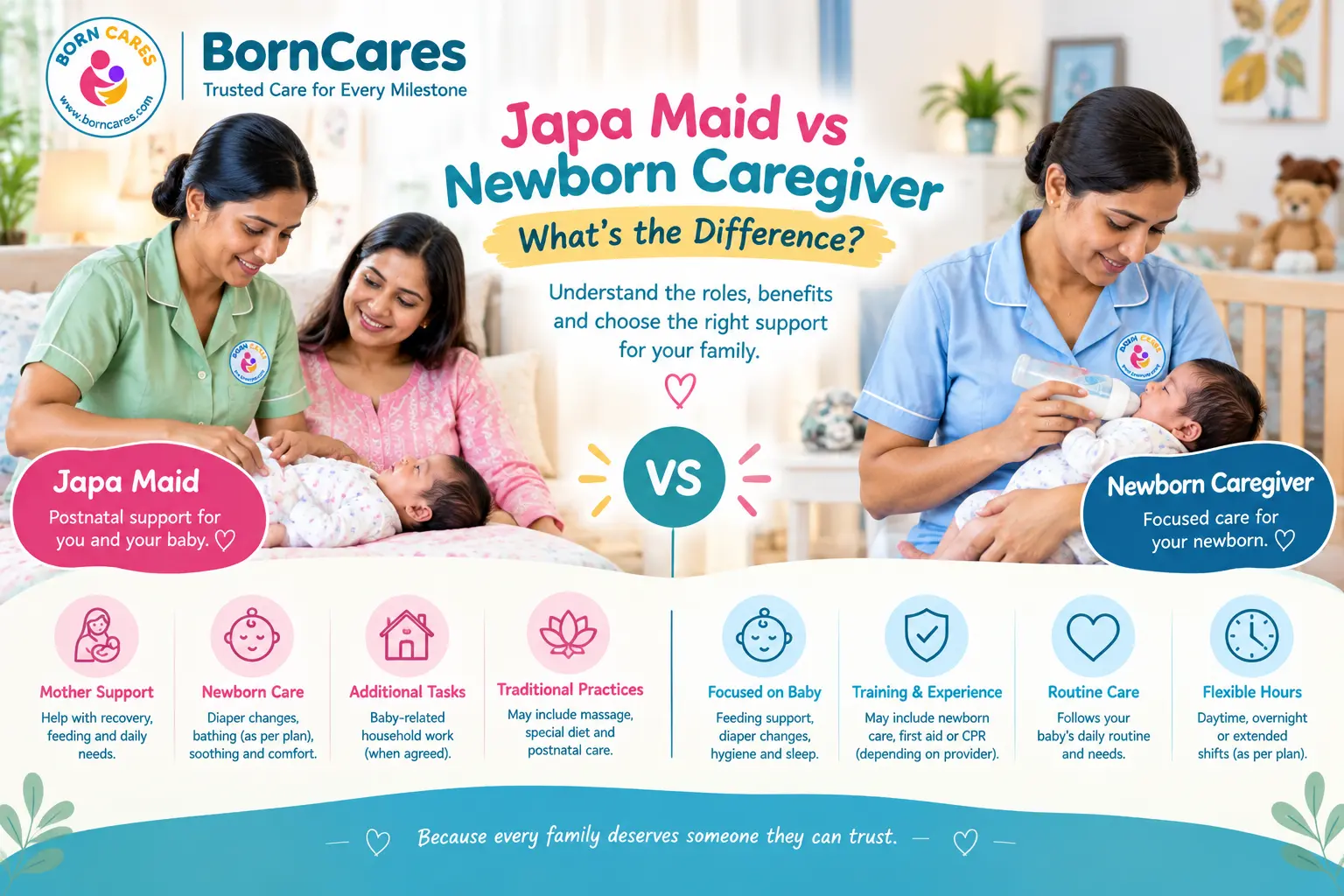
D. Japa maid or postnatal support
Japa maid services are commonly arranged in India to support mothers and newborns after childbirth.
Depending on the arrangement, duties may include routine baby care, feeding-related assistance, and agreed practical support for the mother.
A Japa maid is not automatically a nurse or medical professional. Parents should verify the caregiver’s experience and training.
E. Special child care
Some families need additional support for a child with specific developmental, physical, or daily-care requirements.
The caregiver’s experience and qualifications should match the child’s needs. Specialized medical or therapeutic support should be arranged through appropriately qualified professionals.
5. Benefits of Hiring a Professional Baby Caregiver at Home
Home-based baby-care support can offer practical advantages for families.
A. Care in a familiar environment
The baby remains in the family’s home, surrounded by familiar spaces, supplies, and daily routines.
Parents can explain their preferences and arrange the care environment according to the baby’s needs.
B. Personalized support
Every baby has different feeding, sleeping, and comfort needs.
A caregiver can follow the family’s agreed instructions and help maintain a routine that suits the baby.
C. Support for working parents
Parents who work outside or inside the home may find it difficult to manage every childcare responsibility alone.
A caregiver can provide assistance during agreed working hours and share important updates.
D. Practical support for new mothers
After childbirth, mothers may need time to recover physically and adjust to new responsibilities.
Help with routine baby-care tasks may give mothers more opportunities to rest and focus on their recovery.
E. Better organization of daily routines
With clearly defined responsibilities, parents can organize feeding support, diaper changes, baby hygiene, and other everyday tasks more effectively.
F. Greater confidence for new parents
A caregiver with relevant experience may demonstrate routine baby-care tasks and help parents become more familiar with everyday responsibilities.
The goal should be to support parents, not replace their involvement in the baby’s life.
6. Daytime, Overnight, Part-Time, and Full-Time Baby Care
Baby-care services may be arranged according to the family’s schedule.
The availability of different shifts depends on the provider and location.
Part-time baby care
Part-time support may be suitable for families who need help for a few hours each day.
It can be useful when parents want assistance with particular routines or need time to manage other responsibilities.
Full-time baby care
Full-time arrangements provide support for a longer agreed period during the day.
This may suit working parents or families who need regular assistance with daily childcare.
Overnight baby care
Overnight support may include agreed tasks such as diaper changes, soothing, and bringing the baby to the mother for feeding.
It can help parents rest between the baby’s needs, although uninterrupted sleep cannot be guaranteed.
Extended or live-in arrangements
Some families require longer coverage or a live-in caregiver.
Before confirming, discuss working hours, breaks, sleeping arrangements, weekly days off, and responsibilities.
A single caregiver should not be expected to provide continuous, alert 24-hour care without adequate rest. Families needing round-the-clock coverage should ask how staffing and handovers are managed.
7. How to Choose the Right Baby Caregiver
Choosing a caregiver is an important decision because you are inviting someone into your home to help care for your child.
Here are important points to consider before hiring.
A. Check childcare experience
Ask how long the caregiver has worked with babies and children.
Find out whether they have experience with newborns, infants, or older children, depending on your requirements.
B. Ask about relevant training
Ask whether the caregiver has training in newborn care, infant first aid, or CPR.
Verify any claimed certificates and understand what the training covers.
C. Verify identity and references
Ask the provider about identity verification and reference checks.
Where possible, speak to previous families and ask about reliability, hygiene, communication, and caregiving practices.
D. Discuss responsibilities
Make a clear list of tasks before the caregiver starts.
Discuss feeding assistance, diaper changes, bathing support, baby-related household tasks, working hours, and breaks.
E. Observe communication
A suitable caregiver should listen carefully, follow instructions, respect family preferences, and communicate concerns promptly.
F. Discuss safety practices
Ask how the caregiver handles safe sleep, feeding hygiene, gentle handling, and emergencies.
G. Confirm fees and working hours
Discuss the total cost, payment schedule, extra-hour charges, weekly days off, and replacement arrangements.
Having these details in writing can help avoid misunderstandings.
8. Important Safety Practices Every Baby Caregiver Should Follow
Baby safety should always be a priority.
Parents should make sure that anyone caring for their baby understands and follows appropriate safety practices.
Safe sleeping
Place the baby on their back for every sleep on a firm, flat, separate infant sleep surface.
Keep pillows, loose blankets, and soft toys out of the baby’s sleep area.
Feeding hygiene
Wash hands before handling feeding equipment or preparing feeds.
Follow appropriate guidance for preparing and storing breast milk or formula.
Gentle handling
Always support a newborn’s head and neck.
Never shake a baby or use forceful movements.
Supervision
Babies should never be left unattended on beds, sofas, changing tables, or other elevated surfaces.
Recognizing warning signs
A baby under three months with a temperature of 38°C (100.4°F) or higher needs urgent medical assessment.
Breathing difficulties, blue or grey skin, seizures, or unresponsiveness require emergency help.
Caregivers should contact parents and seek appropriate medical assistance rather than trying to diagnose or treat a serious condition themselves.
9. What Should Parents Prepare Before a Caregiver Arrives?
Preparing your home and sharing clear instructions can help the caregiver understand your expectations.
Consider preparing:
- Baby feeding instructions.
- Diaper-changing supplies.
- Clean baby clothes.
- Towels and washcloths.
- A safe infant sleep space.
- Emergency contact numbers.
- Parent-approved baby-care products.
- Instructions about the baby’s routine.
- Important healthcare guidance provided by your pediatrician.
You should also explain household rules, privacy expectations, mobile phone use, and how daily updates should be shared.
A short written care routine can be useful for everyone involved.
10. How Much Do Baby Care Services at Home Cost?
The cost of home-based baby-care services depends on several factors.
These may include:
- Your city or location.
- The baby’s age and care requirements.
- Caregiver experience and relevant training.
- Part-time or full-time arrangements.
- Daytime or overnight shifts.
- Number of working hours.
- Number of days or weeks required.
- Additional responsibilities.
There is no single price that applies to every family.
Before booking, request a clear quotation and ask whether there are additional charges for extended hours, holidays, travel, or live-in arrangements.
At BornCares, families can enquire about suitable home-based childcare and newborn-care options based on their location and requirements. Contact the provider directly for current availability and pricing.
11. Frequently Asked Questions
What are baby care services at home?
Baby care services at home provide practical childcare assistance in the family’s home. Depending on the arrangement, support may include feeding assistance, diaper changes, hygiene, soothing, and following the baby’s routine.
Are professional baby caregivers suitable for newborns?
Some caregivers have experience with newborns, while others work mainly with older babies or children. Parents should verify the caregiver’s specific newborn-care experience and relevant training.
Can a baby caregiver help with feeding?
A caregiver may provide practical feeding-related assistance according to the parents’ instructions. Breastfeeding or medical feeding concerns should be discussed with a qualified healthcare professional.
Can I hire a caregiver for only a few hours?
Some providers offer part-time or short-duration arrangements. Availability and minimum booking hours vary, so confirm the details before booking.
What is the difference between a babysitter and a nanny?
A babysitter is commonly hired for occasional or shorter-term childcare, while a nanny usually provides more regular childcare support. The exact responsibilities depend on the agreement.
Is home-based baby care better for working parents?
It can be a practical option for families who need childcare assistance at home during working hours. Parents should choose a caregiver whose experience and schedule match their requirements.
How do I find a trustworthy baby caregiver?
Check experience, training, references, identity verification, communication, safety practices, and working arrangements. Discuss duties and payment terms clearly before hiring.
Conclusion
Caring for a baby requires patience, attention, and consistent everyday support. From feeding and diaper changes to hygiene and safe sleeping routines, parents manage many responsibilities while adjusting to their new family life.
Professional baby care services at home can provide practical assistance with these everyday tasks. Depending on the service arrangement, caregivers may help with newborn care, babysitting, nanny support, and other childcare needs.
The most important step is choosing a suitable and reliable caregiver who respects your family’s preferences, understands their responsibilities, and follows appropriate baby-safety practices.
At BornCares, we believe every family deserves someone they can trust. Our goal is to help parents explore suitable home-based childcare support so they can approach everyday parenting responsibilities with greater confidence.
Because every family deserves someone they can trust.
Health note: This article provides general educational information and does not replace medical advice. Consult qualified healthcare professionals about newborn health, feeding difficulties, and any medical concerns.