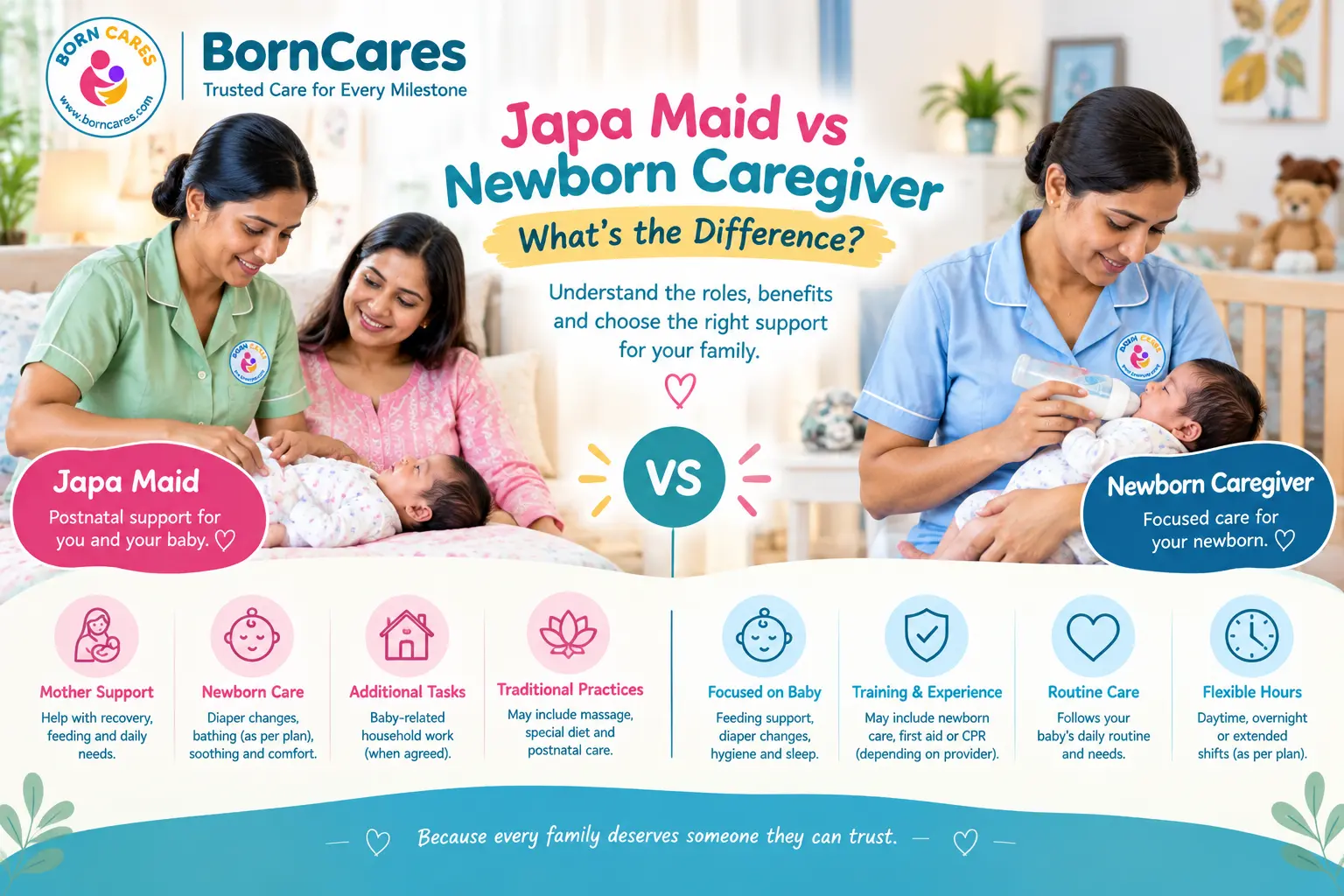

Bringing a newborn home is a beautiful experience, but caring for a baby around the clock can be challenging. Newborns need frequent feeding, diaper changes, comforting, and attention throughout the day and night. For many parents, especially first-time parents and working families, deciding what type of newborn care support they need is an important step.
Some families need help during the day while they work, rest, or manage household responsibilities. Others find nighttime support more helpful because their baby wakes frequently and parents struggle with interrupted sleep. Some families may benefit from both daytime and overnight newborn care, depending on their needs and budget.
Understanding the difference between daytime and overnight newborn care can help parents choose suitable support for their family.
At BornCares, we believe every family deserves someone they can trust. This guide explains what daytime and overnight newborn care involve, their benefits, the questions parents should ask, and how to decide which option may be right for them.
1. What Is Daytime Newborn Care?
Daytime newborn care is support provided during the day to help parents manage their baby’s daily needs. Depending on the arrangement, a newborn caregiver may work for a few hours, a half-day, or a full daytime shift.
Daytime care can be useful for parents returning to work, recovering after childbirth, managing other children, or needing practical help with newborn routines.
What does a daytime newborn caregiver do?
The caregiver’s responsibilities depend on their training, the family’s requirements, and the agreed working hours. Duties may include:
- Helping with routine diaper changes and baby hygiene.
- Supporting feeding according to the parents’ instructions and the baby’s needs.
- Burping the baby when needed.
- Comforting the baby with gentle, age-appropriate methods.
- Helping prepare the baby’s sleeping area and following safe-sleep practices.
- Washing or organizing baby-care items as agreed.
- Observing changes in feeding, behavior, or diaper output and informing the parents.
- Helping parents maintain a consistent daily routine.
A newborn caregiver should not replace a doctor, midwife, or other qualified healthcare professional. Medical concerns should always be referred to an appropriate professional.
Who may benefit from daytime newborn care?
Daytime support may be suitable for:
- Parents working from home or outside the home.
- Families with older children who also need attention.
- Parents who need practical support after childbirth.
- First-time parents learning basic newborn-care routines.
- Families who need help during particular hours rather than overnight.
- Parents who have family support available at night but need help during the day.
Daytime care can give parents more time to work, rest, eat regularly, attend appointments, or spend time with their other children.
2. What Is Overnight Newborn Care?
Overnight newborn care provides support during nighttime hours. It is designed to help families manage the baby’s nighttime needs while ensuring that care continues when parents are tired or need rest.
Newborns often wake during the night for feeding, diaper changes, and comfort. Their sleep patterns vary, and many do not follow a predictable nighttime schedule during the early weeks.
An overnight caregiver helps with agreed nighttime tasks so parents can rest when possible. However, overnight care does not guarantee uninterrupted sleep because feeding and other needs may still require a parent’s involvement.
What does an overnight newborn caregiver do?
Depending on the caregiver’s training and the family’s plan, responsibilities may include:
- Responding when the baby wakes.
- Changing diapers and providing routine hygiene.
- Bringing the baby to a breastfeeding parent when needed.
- Supporting bottle-feeding according to the parents’ feeding plan.
- Burping and gently comforting the baby.
- Placing the baby on their back in a safe sleep space after care.
- Observing and communicating changes in the baby’s behavior or condition.
- Keeping a simple record of feeds, diaper changes, and other agreed observations.
Parents should discuss feeding arrangements before the caregiver starts. A caregiver should never change a baby’s feeding plan or give medication without appropriate parental authorization and healthcare guidance.
Who may benefit from overnight newborn care?
Overnight support may be helpful for:
- Parents experiencing significant sleep disruption.
- Families without relatives available to assist at night.
- Parents recovering after childbirth who need practical help.
- Families with more than one young child.
- Parents who feel uncertain about nighttime newborn routines.
- Families who want experienced support while learning how to care for their baby.
Parents should also discuss any health concerns with their baby’s doctor, particularly if the baby was born prematurely, has feeding difficulties, or needs specialized care.
3. Daytime vs Overnight Newborn Care: Key Differences
Both options focus on supporting the baby, but the timing and family benefits are different.
| Feature | Daytime Newborn Care | Overnight Newborn Care |
|---|---|---|
| Main hours | Morning, afternoon, or daytime shifts | Evening, nighttime, or early morning shifts |
| Main purpose | Help with daily baby care and family routines | Help manage nighttime baby care |
| Common tasks | Feeding support, diaper changes, soothing, baby hygiene | Night feeds as agreed, diaper changes, soothing, safe sleep |
| Parent benefit | More time for work, rest, appointments, or other children | Opportunities for rest during parts of the night |
| Often suitable for | Working parents and families needing daytime help | Parents struggling with nighttime routines or sleep disruption |
| Schedule | Fixed daytime hours or flexible shifts | Fixed overnight shifts or agreed night hours |
| Important consideration | Baby still needs safe supervision throughout the shift | Nighttime duties and whether the caregiver is expected to remain awake must be clear |
The right choice depends on your family’s routine, the baby’s needs, available support, and budget.
4. Benefits of Daytime Newborn Care
Daytime support can make daily life more manageable, particularly during the first few weeks after birth.
Support with everyday routines
Newborn care involves many repeated tasks, including feeding, changing, cleaning, and settling. A caregiver can help with agreed responsibilities so parents do not feel they must manage everything alone.
More time for work
Parents working from home may find it difficult to concentrate while caring for a newborn. Daytime care can provide dedicated support during work hours, although parents should establish clear arrangements for breaks, emergencies, and their own involvement.
Help for parents recovering after childbirth
The period after childbirth can involve physical recovery, emotional changes, and disrupted sleep. Practical help with routine baby care may allow a parent to rest, eat, and attend appointments.
Support for the whole family
When a new baby arrives, older children may also need attention. Daytime help can give parents more flexibility to spend time with their other children while ensuring the newborn receives appropriate care.
Opportunities to learn
A responsible caregiver can demonstrate routine tasks and help parents become more confident. Parents should feel comfortable asking questions and remaining involved in their baby’s care.
5. Benefits of Overnight Newborn Care
Nighttime can be especially challenging because newborns do not yet have a mature day-and-night sleep pattern.
Help with nighttime tasks
An overnight caregiver can assist with agreed duties such as diaper changes, settling, and bringing the baby to a parent for feeding. This may reduce the number of tasks a parent has to manage alone.
Opportunities for parental rest
When feeding and other responsibilities are shared appropriately, parents may get more opportunities to rest between the baby’s needs. How much rest is possible depends on the baby’s feeding pattern and the agreed duties.
Support for families without nearby relatives
Some families live far from relatives or do not have someone available to help at night. A planned overnight care arrangement can provide practical assistance during this period.
Help with consistent routines
A caregiver can follow the family’s agreed approach to soothing, diaper changes, and safe sleep. Consistency between caregivers can make communication easier, although newborn sleep remains unpredictable.
Greater confidence during the early weeks
First-time parents may feel anxious when their baby wakes frequently or cries at night. A caregiver with suitable newborn-care experience can help with routine tasks and explain when a concern should be discussed with a healthcare professional.
6. Which Option Is Better for First-Time Parents?
There is no single answer for every family. The better option depends on which part of the day feels most difficult and what support is already available.
Choose daytime care if you mainly need help with daily baby-care tasks, work responsibilities, household coordination, or recovery after childbirth.
Consider overnight care if nighttime duties are especially challenging and you need help managing feeds, diaper changes, and settling while you rest when possible.
Consider both daytime and overnight support if your family needs help across a longer period and your budget allows it. You do not necessarily need full-day or full-night support every day; some families arrange care only during their most demanding hours.
Before deciding, ask yourself:
- At what time do we need the most help?
- Is one parent available during the day or night?
- What tasks do we want the caregiver to handle?
- Does the baby have any special feeding or healthcare needs?
- How many hours can we reasonably afford?
- What level of training or experience is needed?
Write down your priorities before contacting a care provider. This makes it easier to compare options fairly.
7. Should Parents Choose Part-Time, Full-Time, or 24-Hour Support?
Newborn-care arrangements can vary in duration. The terms used by providers may differ, so always confirm the exact working hours, breaks, responsibilities, and staffing arrangements.
Part-time newborn care
Part-time support is suitable for families who need help for a limited period, such as a few hours during the day or selected nighttime hours.
It may be useful if parents can handle most care themselves but need assistance with particular tasks or time periods.
Full-time daytime care
Full-time daytime care may suit working parents or families who need regular help throughout the day. Confirm the daily schedule, breaks, days off, and any duties outside newborn care.
Overnight care
Overnight care is arranged for specified nighttime hours. Clarify whether the caregiver is expected to remain awake throughout the shift, what happens when the baby needs feeding, and whether the caregiver can rest during quiet periods.
Extended or 24-hour support
Some families may require support across much of the day and night. A single caregiver should not automatically be assumed to be available and alert for 24 hours. Adequate rest, safe working hours, breaks, and any handover arrangements must be planned carefully.
Ask the provider how continuous coverage is staffed and how responsibility is transferred between caregivers. A clear plan protects both the baby and the people providing care.
8. How Much Does Daytime or Overnight Newborn Care Cost?
The cost of newborn care varies by city, shift length, experience, responsibilities, and the level of care required. Overnight rates may differ from daytime rates, and extended shifts may involve additional charges.
Before comparing prices, ask each provider for a clear written breakdown.
Consider these factors:
- Number of hours per shift.
- Number of days per week.
- Caregiver experience and relevant training.
- Whether overnight work is included.
- Whether the arrangement is live-in or live-out.
- Travel or accommodation costs, if applicable.
- Extra charges for holidays, additional hours, or urgent bookings.
- Whether specialized care is required.
Do not choose a caregiver on price alone. Identity checks, references, communication, relevant experience, and a clear emergency plan are important.
BornCares families can enquire about available care options and request pricing based on their location, schedule, and newborn-care requirements. Confirm the current rates directly with the provider before making a decision.
9. How to Choose a Reliable Newborn Caregiver
Whether you choose daytime or overnight support, selecting the right person is essential.
Check relevant experience
Ask about the caregiver’s experience with newborns of a similar age and whether they have supported families with comparable needs.
Ask about training
Find out whether the caregiver has infant first aid or CPR training and understands safe sleep, feeding hygiene, and signs that require medical attention.
Verify identity and references
Ask the provider what identity checks and reference checks have been completed. Where appropriate, contact references and ask about reliability, communication, and care practices.
Discuss responsibilities clearly
Write down the tasks the caregiver will handle, the hours, breaks, payment terms, and expectations for communicating with parents.
Assess communication
A caregiver should be willing to listen to your instructions, report concerns, and ask questions when something is unclear.
Explain safe-sleep rules
Every caregiver should place the baby on their back for sleep, use a firm and flat infant sleep surface, and keep pillows, loose blankets, and soft toys out of the sleep space.
Plan for emergencies
Discuss whom to call, where emergency contacts are kept, and what the caregiver should do if the baby has difficulty breathing, becomes unresponsive, or shows other urgent warning signs.
10. Important Safety Considerations for Daytime and Overnight Care
Safe care matters at every hour.
Safe sleep: Place the baby on their back for every sleep on a firm, flat, separate infant sleep surface. Keep the cot free of pillows, loose bedding, and soft toys.
Feeding: Follow the baby’s feeding plan and appropriate hygiene practices. Never force a feed or make unapproved changes to formula, feeding frequency, or medication.
Supervision: The caregiver should understand the baby’s needs and know when to alert the parents or seek medical help.
Communication: Parents should receive clear updates about feeds, diapers, sleep, and any unusual behavior, as agreed.
Medical concerns: A caregiver should not diagnose illness or delay medical attention. For a baby under three months, a temperature of 38°C (100.4°F) or higher requires urgent medical assessment. Breathing difficulty, blue or grey skin, seizures, or unresponsiveness require emergency help.
Special circumstances, including premature birth or medical conditions, may require individualized instructions from the baby’s healthcare team.
11. Can Parents Combine Daytime and Overnight Newborn Care?
Yes. Some families find that combining different types of support is more practical than choosing only one.
For example:
- A working parent may arrange daytime care on weekdays and manage nights with family support.
- Parents recovering after childbirth may arrange daytime help during the first weeks and add occasional overnight shifts when needed.
- A family with limited support may arrange overnight care on selected nights rather than every night.
- Parents of twins may need a carefully planned combination of daytime and nighttime help.
The best schedule is one that meets the baby’s needs, supports the parents, and allows caregivers to work safely with adequate rest.
Review the arrangement as your baby grows. Your needs in the first few weeks may differ from your needs several months later.
12. Frequently Asked Questions
Is daytime or overnight newborn care better?
Neither option is best for every family. Daytime care helps with daily routines and work responsibilities, while overnight care helps manage nighttime duties. Choose based on when your family needs the most support.
Does overnight newborn care mean parents can sleep all night?
Not necessarily. Newborns may wake frequently, and feeding arrangements may require a parent’s involvement. Discuss duties and expectations with the caregiver before the shift begins.
How many hours of newborn care should we book?
The right number of hours depends on your schedule, available family support, budget, and baby’s needs. Start by identifying the times when you need the most help.
Can a newborn caregiver help with breastfeeding?
A caregiver may assist with practical tasks, such as bringing the baby to the breastfeeding parent, helping with positioning under the parent’s direction, and burping when appropriate. For breastfeeding difficulties or concerns about milk supply, seek support from a qualified lactation professional or healthcare provider.
Is a caregiver suitable for a premature baby?
Some premature babies need specialized monitoring or medical care. Discuss the baby’s individual needs with the healthcare team and choose a caregiver with appropriate experience and training. A general newborn-care arrangement may not be sufficient for medically complex needs.
When should we book newborn care?
If possible, begin researching options before the baby arrives. This gives you time to compare providers, check references, discuss responsibilities, and arrange support. Availability may vary, so confirm dates directly with the provider.
Conclusion
Choosing between daytime and overnight newborn care depends on your family’s routine, the baby’s needs, and the type of support that would make daily life easier.
Daytime care may be the better fit when parents need help with daily tasks, work, or recovery. Overnight care may be useful when nighttime duties are especially challenging and parents need more opportunities to rest. Some families benefit from combining both options for a limited period.
Before hiring a caregiver, check relevant experience, ask about training and references, agree on responsibilities, and make sure safe-sleep and emergency procedures are understood.
At BornCares, we understand that every family’s needs are different. The right support should help parents feel informed and supported while ensuring that the newborn receives attentive, appropriate care.
Because every family deserves someone they can trust.
Health note: This article provides general educational information. For medical concerns, feeding difficulties, premature-baby care, or questions about your newborn’s health, consult a qualified healthcare professional.