
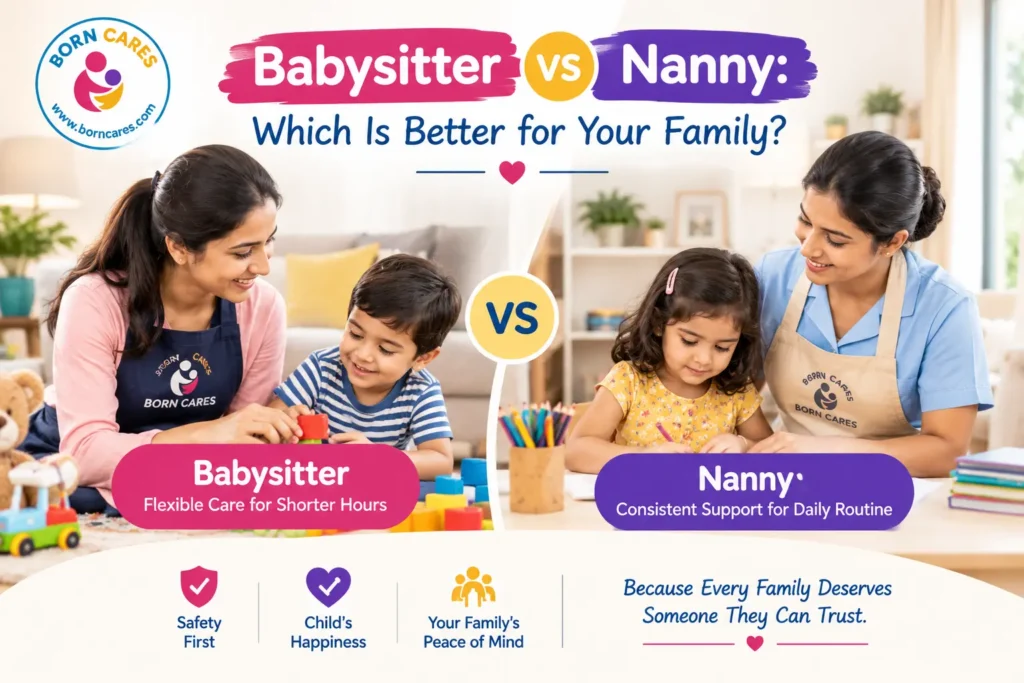
Choosing the right childcare support is an important decision for every parent. Whether you are returning to work, managing household responsibilities, or looking for extra help with your child’s daily routine, having the right caregiver can make family life easier.
Many parents in India ask the same question: Should I hire a babysitter or a nanny?
Although these terms are sometimes used interchangeably, babysitters and nannies may have different responsibilities, working arrangements, and levels of involvement in a child’s daily routine. The right choice depends on your child’s age, your family’s schedule, your budget, and the type of support you need.
In this guide, we will explain the difference between a babysitter and a nanny, compare their responsibilities, discuss their benefits, and help you decide which option may be better for your family.
What Is a Babysitter?
A babysitter is someone who looks after a child for an agreed period. Babysitters are often hired for a few hours, occasional evenings, weekends, or specific times when parents need additional childcare support.
For example, parents may need a babysitter while attending an appointment, working from home, completing important tasks, or going out for a short period.
A babysitter’s main responsibility is to supervise the child and help maintain their safety and comfort during the agreed working hours.
Common responsibilities of a babysitter
Depending on the arrangement, a babysitter may:
- Supervise children while they play.
- Help with snacks or meals prepared for the child.
- Change diapers and assist with basic hygiene.
- Read stories or organize age-appropriate activities.
- Follow the child’s usual nap or bedtime routine.
- Inform parents about the child’s activities and any concerns.
The exact duties should always be discussed before hiring.
Babysitting does not automatically include cooking for the entire family, general household cleaning, or other domestic work. Any additional responsibilities should be agreed upon clearly.
What Is a Nanny?
A nanny generally provides more regular childcare support and may become an important part of a child’s everyday routine.
Families often hire nannies for recurring part-time or full-time arrangements. Depending on the agreement, a nanny may work for several hours each day or provide care according to a longer schedule.
A nanny may help parents maintain consistency in their child’s meals, playtime, learning activities, rest, and other daily needs.
Common responsibilities of a nanny
Depending on the family’s requirements, a nanny may:
- Provide regular supervision and childcare.
- Follow the child’s daily routine.
- Help with feeding and age-appropriate meals.
- Support diaper changes and personal hygiene.
- Arrange educational and recreational activities.
- Help maintain the child’s sleep routine.
- Keep the child’s play area organized.
- Communicate with parents about the child’s day.
Some families also need nannies with experience caring for newborns or children who require additional support. Relevant experience and responsibilities should be verified rather than assumed.
A nanny’s role varies from family to family, so it is important to discuss working hours, duties, experience, and payment before making a decision.
The biggest difference is often the working arrangement and the level of regular involvement in a child’s routine. However, the terms can overlap, and job titles alone do not define the actual responsibilities.
Babysitter vs Nanny: What Is the Difference?
Here is a simple comparison to help you understand the options.
| Feature | Babysitter | Nanny |
|---|---|---|
| Typical arrangement | Often occasional or short-term | Often regular or ongoing |
| Working hours | A few hours or specific periods | Recurring part-time or full-time hours |
| Main responsibility | Supervision and agreed childcare tasks | Regular childcare and routine support |
| Daily routine | Follows instructions for the care period | May help maintain a consistent daily routine |
| Activities | Play, supervision, meals, and bedtime as agreed | Play, meals, rest, and other agreed daily activities |
| Best suited for | Occasional childcare needs | Families needing regular childcare support |
| Flexibility | May be hired for specific occasions | Usually follows an agreed recurring schedule |
| Cost structure | May be charged hourly or per session | May be charged hourly, daily, or monthly |
These are general patterns, not strict rules. A babysitter may work regularly, and a nanny may also be hired part-time. Always compare the actual services being offered.
1. Which Option Is Better for Your Daily Schedule?
Your family’s routine is one of the most important factors when choosing between a babysitter and a nanny.
When a babysitter may be suitable
A babysitter may be a good option if you need occasional help rather than daily childcare.
For example, you may need someone to supervise your child while you attend a meeting, manage an appointment, or handle an unexpected responsibility.
If your childcare needs vary from week to week, an occasional babysitting arrangement may offer the flexibility you want.
When a nanny may be suitable
A nanny may be more suitable if you need consistent childcare during regular working hours.
For example, parents who work full-time may prefer a caregiver who follows a predictable schedule and becomes familiar with their child’s routines and preferences.
A regular caregiver may also help parents coordinate meals, playtime, rest, and other everyday activities.
Helpful tip: Write down your weekly schedule before contacting a childcare service. This makes it easier to explain your requirements and compare suitable arrangements.
2. Which Option Is Better for Babies and Toddlers?
A child’s age and individual needs should influence your childcare decision.
For newborns
Newborns need careful handling, feeding support, hygiene, and safe sleeping arrangements.
If you need help caring for a newborn, look for a caregiver with relevant newborn-care experience. Ask about safe sleep practices, feeding instructions, hygiene, and how they respond when a baby appears unwell.
A nanny with suitable experience may be appropriate for regular newborn care. A babysitter with verified newborn-care skills may also be suitable for shorter periods.
The important factor is the caregiver’s actual experience and competence, not simply their job title.
For toddlers
Toddlers need close supervision because they are curious, active, and still learning about their surroundings.
They may need help with meals, toilet routines, playtime, and emotional regulation.
If you need occasional support during a particular period, a babysitter may work well. If you need help throughout most weekdays, a nanny may be a better fit.
In either case, explain your child’s habits, safety needs, allergies, and daily routine before the caregiver begins.
3. What About Experience and Qualifications?
Experience is an important consideration when choosing any childcare professional.
However, the right experience depends on your child’s needs and the responsibilities involved.
When interviewing a babysitter or nanny, ask:
- How long have you worked in childcare?
- What age groups have you cared for?
- Have you handled responsibilities similar to those required by our family?
- Can you provide references from previous childcare work?
- Do you have relevant first-aid or childcare training?
- Are you familiar with child safety and emergency procedures?
Verify references and any claimed qualifications where possible.
If you need specialized support, such as newborn care or care for a child with additional needs, explain those requirements in advance and check whether the caregiver has relevant experience.
Do not assume that every nanny has formal childcare qualifications or that every babysitter lacks them. Evaluate each person individually.
4. Babysitter vs Nanny: Which Is More Affordable?
Cost is another important factor for families comparing childcare options.
The price of a babysitter or nanny can vary depending on your city, working hours, responsibilities, experience, and type of care required.
Babysitter costs
Babysitters may charge by the hour, by the session, or according to another agreed arrangement.
If you need care only occasionally, paying for specific hours may suit your budget.
However, if you need a babysitter for many hours every day, the total cost can add up.
Nanny costs
Nannies may charge hourly, daily, weekly, or monthly, depending on the arrangement.
Regular schedules and additional responsibilities can influence the total fee.
Families should also clarify whether overtime, transport, meals, holidays, or other arrangements involve additional costs.
How can you compare costs?
Before deciding, request clear quotations from suitable caregivers or service providers.
Compare the following:
- Total working hours.
- Agreed childcare responsibilities.
- Relevant experience.
- Schedule flexibility.
- Additional charges.
- Payment terms and notice periods.
Avoid choosing solely on the basis of the lowest price. A suitable arrangement should balance affordability, safety, reliability, and your child’s needs.
5. What About Flexibility and Availability?
Flexibility can be especially important for parents with changing work schedules.
Babysitters are often hired for specific periods, making them useful when parents need occasional help. However, availability varies from one caregiver to another, so last-minute arrangements should not be assumed.
Nannies generally work according to an agreed recurring schedule. This can help families plan their day more consistently.
If your working hours change frequently, discuss the possibility of schedule changes, additional hours, or backup arrangements before hiring.
For either option, agree on what happens if the caregiver is unavailable or you need to extend the working hours.
Clear communication helps prevent misunderstandings and makes childcare arrangements easier to manage.
6. Which Option Offers More Consistency for Your Child?
Children often become more comfortable when they know what to expect from the people caring for them.
A caregiver who regularly looks after your child may become familiar with their preferences, routines, and communication style.
A nanny working on a recurring schedule may offer this kind of consistency.
However, a regular babysitter can also build a familiar relationship with a child if they provide care frequently.
When choosing a caregiver, consider how they interact with your child. Look for patience, attentiveness, respectful communication, and a willingness to follow your family’s routines.
Arrange an introduction before the first longer care period where possible. Give your child time to become comfortable, and pay attention to any concerns.
No job title can guarantee a strong relationship. Consistency, suitability, and the caregiver’s behaviour matter more.
7. What Safety Checks Should Parents Complete?
Whether you hire a babysitter or a nanny, child safety should remain your priority.
Before hiring, consider these practical steps:
Check references: Contact previous families where possible and ask about their experience with the caregiver.
Verify relevant information: Check identity, work history, and claimed qualifications as appropriate and lawful.
Discuss emergencies: Ask how the caregiver would respond to an accident or a child becoming seriously unwell.
Explain household safety rules: Show the caregiver where the child can play, sleep, and eat safely.
Share important information: Explain allergies, relevant medical needs, emergency contacts, and your child’s routine.
Observe interactions: Arrange an introduction and pay attention to how the caregiver communicates with and supervises your child.
If you use a childcare agency or service provider, ask what screening procedures it actually performs. Do not assume that all providers follow the same process.
These checks help you make a more informed decision, although no single check can guarantee that a caregiver will always behave appropriately.
8. Can a Babysitter or Nanny Help With Household Tasks?
This depends on the specific agreement.
A babysitter’s main role is generally to supervise and care for the child during the agreed period.
A nanny may also handle child-related tasks, such as preparing the child’s meals, organizing toys, or tidying the child’s play area, if those duties are included in the arrangement.
However, general household chores should not be assumed to be part of either role.
Before hiring, discuss:
- Whether meal preparation is included.
- Whether the caregiver will tidy the child’s belongings.
- Whether laundry related to the child is expected.
- Whether any additional duties will be required.
- Whether the agreed fee changes if responsibilities increase.
A written list of duties can help both parents and caregivers understand their expectations.
9. How Do You Choose the Right Caregiver for Your Family?
Once you understand the differences, use these steps to make your decision.
Step 1: Identify your childcare needs
Decide whether you need occasional, regular part-time, full-time, newborn, or specialized childcare support.
Step 2: Set your schedule and budget
Determine your required hours and the amount you can reasonably spend.
Step 3: Discuss experience and responsibilities
Ask relevant questions and confirm that the caregiver understands the tasks involved.
Step 4: Check references and relevant information
Verify the information available to you and ask about the provider’s screening process if you are using a service.
Step 5: Arrange an introduction
Where possible, let the caregiver meet your child while you are present.
Step 6: Agree on everything clearly
Confirm working hours, duties, payment, emergency procedures, and communication expectations.
Taking these steps can help you choose an arrangement that fits your family more confidently.
10. How BornCares Can Help You Explore Childcare Options
Every family has different childcare requirements. Some parents need help for a few hours, while others need regular support with a child’s everyday routine.
BornCares helps families explore home-based care options, including babysitter services, nanny services, newborn care, Japa maid services, and special child care.
When discussing your requirements, share your child’s age, location, preferred working hours, and the type of support you need. This helps clarify which available service may be appropriate for your family.
Before making a final decision, discuss the caregiver’s responsibilities, experience, availability, and the relevant screening process.
Visit BornCares to explore available services and discuss your family’s childcare needs.
Frequently Asked Questions (FAQs)
1. Is a babysitter the same as a nanny?
Not always. A babysitter is often hired for occasional or shorter periods, while a nanny commonly provides regular childcare. However, the terms can overlap, so always confirm the actual responsibilities and working arrangements.
2. Is a babysitter or nanny better for a working mother?
A nanny may be suitable if you need regular childcare throughout working hours. A babysitter may work better if you need occasional support. The right choice depends on your schedule, budget, and child’s needs.
3. Can I hire a babysitter for a full day?
Yes, if the caregiver offers that arrangement and the working hours, responsibilities, breaks, and payment terms are agreed upon in advance.
4. Should I hire a nanny for my newborn?
A nanny with relevant newborn-care experience may be suitable for regular support. For any caregiver, verify experience with safe sleep, feeding support, hygiene, and appropriate emergency procedures.
5. Which is cheaper, a babysitter or a nanny?
There is no universal answer. The total cost depends on the number of hours, city, responsibilities, experience, and payment arrangement. Compare quotations based on the same requirements.
6. Can a nanny work part-time?
Yes. Some nannies provide part-time care. Availability and working arrangements vary, so discuss the schedule before hiring.
7. What questions should I ask before hiring a caregiver?
Ask about experience, references, availability, child safety, emergency response, daily routines, responsibilities, and fees.
8. How do I know if a caregiver is suitable for my child?
Check relevant information, discuss expectations, observe interactions, and consider whether the caregiver’s experience matches your child’s needs. Continue to monitor the arrangement and take any safety concerns seriously.
Conclusion
Choosing between a babysitter and a nanny depends on the type of childcare support your family needs.
A babysitter may be a practical option for occasional help, while a nanny may be better suited to regular childcare and daily routine support. However, these roles can overlap, so it is important to compare actual duties, experience, availability, and costs.
Before hiring, prioritize safety, check references, communicate clearly, and give your child time to become familiar with the caregiver.
The best choice is not necessarily the person with a particular job title. It is the caregiver whose experience, working arrangement, and approach to childcare suit your family’s needs.
Looking for childcare support at home?
Explore babysitter and nanny services through BornCares and discuss the type of care that may work best for your family.
BornCares — Because every family deserves someone they can trust.