
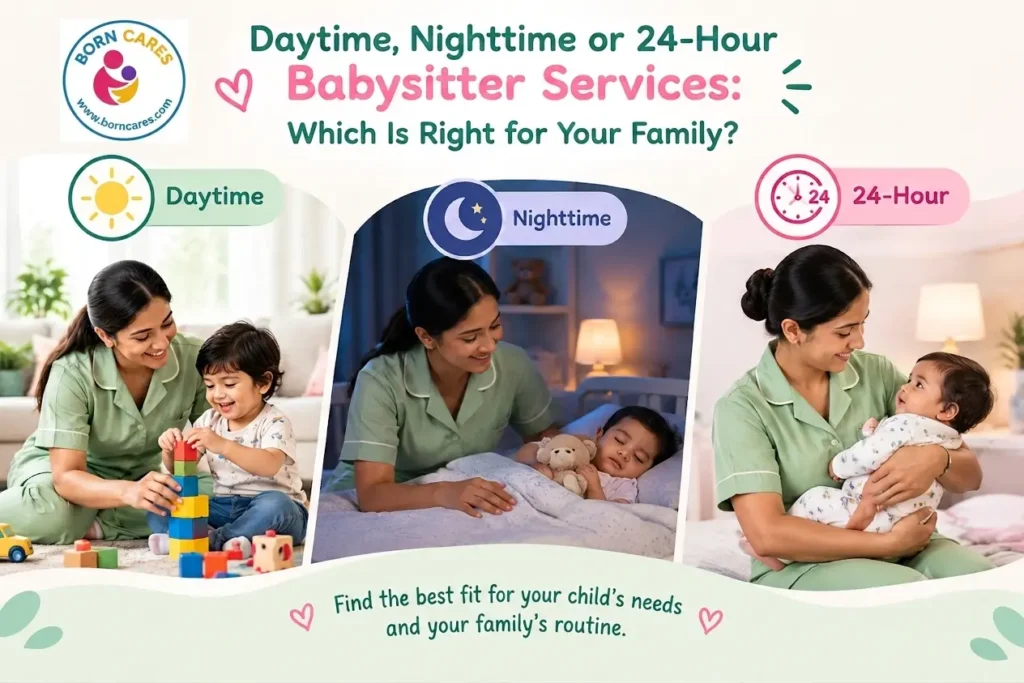
Every family has a different routine.
Some parents need childcare only during working hours. Others need help in the evening because their work schedule extends late into the night. Families with newborns may need additional support around feeding, settling, and unpredictable sleep schedules.
This is why choosing Babysitter Services is not simply about finding a caregiver who is available.
You also need to think about when you need childcare, how many hours you need support, what your child requires, and what arrangement will work comfortably for your family.
You may be wondering:
Should I hire a daytime babysitter?
Would nighttime childcare be more useful?
Do I really need 24-hour babysitter services?
The answer depends on your family’s lifestyle and your child’s needs.
This guide will help you understand the different options so you can make a more informed decision without feeling pressured to choose one particular arrangement.
Why the Timing of Childcare Matters
Childcare needs can change throughout the day.
During the daytime, a child may need meals, playtime, supervision, activities, and help following their normal routine.
At night, the focus may shift toward dinner, bedtime routines, settling, and supervision while parents work or rest.
For newborns, the situation can be different again. Babies may wake frequently, require feeding, need diaper changes, or simply need reassurance during the night.
The right caregiver schedule should therefore match your family’s actual routine rather than someone else’s idea of what childcare should look like.
Before hiring a caregiver, think about when you genuinely need help.
Daytime Babysitter Services: When Do They Make Sense?
Daytime childcare is often suitable for parents who need support during working hours or while managing daily responsibilities.
For example, a parent working from home may need someone to care for their child during meetings or focused work periods.
A parent who works outside the home may need childcare throughout their working day.
Daytime Babysitter Services at Home may include responsibilities such as:
- Supervising the child
- Supporting meals and snacks
- Following nap routines
- Organizing age-appropriate activities
- Providing playtime
- Helping with basic child-related routines
- Maintaining a safe environment
- Keeping parents informed about the child’s day
The exact responsibilities should always be agreed upon before the caregiver begins.
Daytime Care May Be Suitable If:
You work regular daytime hours
If you need childcare while you are at work, daytime support may fit naturally into your schedule.
You work from home
Being at home does not necessarily mean you can supervise your child throughout the day. Meetings, deadlines, and focused work may require uninterrupted time.
Your child needs regular daytime supervision
Young children often need active supervision and engagement rather than simply having an adult nearby.
You need support with a newborn
Parents may need additional help during the day with feeding routines, diaper changes, soothing, and general newborn care.
Nighttime Babysitter Services: When Might You Need Them?
Nighttime childcare can be useful for families whose schedules do not end when the sun goes down.
Parents working evening or night shifts may need someone to care for their child while they are at work.
Other parents may occasionally need evening support for appointments, events, or other commitments.
Nighttime care can involve:
- Dinner support
- Quiet activities
- Bedtime routines
- Helping the child settle
- Supervision while the child sleeps
- Communicating with parents if the child wakes or something unexpected happens
For newborns, nighttime care requires additional consideration because babies may wake for feeding, diaper changes, soothing, or other routine needs.
Parents should clearly explain their baby’s nighttime routine and expectations to the caregiver.
Nighttime Care May Be Suitable If:
You work night shifts
A caregiver can provide supervision while you are working.
Your work schedule regularly extends into the evening
If you frequently return home late, nighttime childcare may make your routine easier to manage.
You occasionally need evening support
You may not need a full-time caregiver if your need is limited to particular evenings.
You have a newborn and need additional support
Some families may want additional help with nighttime newborn routines, depending on their individual circumstances.
What Are 24-Hour Babysitter Services?
The phrase 24-Hour Babysitter Services can mean different things depending on the childcare arrangement.
Parents should not assume that “24-hour” automatically means one caregiver continuously works for 24 hours.
A continuous 24-hour period of childcare involves significant considerations around working hours, rest, shift arrangements, responsibilities, and caregiver well-being.
In many cases, extended or around-the-clock childcare is better organized through shifts or multiple caregivers, depending on the family’s requirements and the service arrangement.
This is particularly important when families need long-duration support for a newborn, a child requiring close supervision, or parents with demanding schedules.
Before choosing an extended-care arrangement, ask exactly:
- What are the caregiver’s working hours?
- How are rest periods handled?
- Is care provided by one caregiver or multiple caregivers?
- What happens during caregiver breaks?
- What responsibilities are included?
- How is overnight care structured?
- What happens if the scheduled caregiver is unavailable?
Clear answers can prevent misunderstandings later.
When Might Extended or 24-Hour Childcare Be Useful?
Extended childcare may be considered by families who have particularly demanding schedules.
For example:
- Parents working rotating shifts
- Families needing extended newborn support
- Parents with irregular work schedules
- Families requiring overnight supervision
- Households looking for continuous childcare arrangements
- Situations where parents need additional support for longer periods
However, not every family needs this level of care.
If you only need support for six or eight hours during the day, a daytime arrangement may be simpler and more appropriate.
The best childcare plan is usually the one that provides enough support without creating unnecessary complexity.
Daytime vs Nighttime vs Extended Care
A simple comparison can help.
| Childcare Option | May Suit Families Who Need | Typical Focus |
| Daytime Babysitter Services | Workday or daytime support | Meals, play, supervision, naps and routines |
| Nighttime Babysitter Services | Evening or overnight support | Dinner, bedtime, settling and supervision |
| Extended/24-Hour Care | Longer or irregular support needs | Ongoing childcare according to agreed shifts and responsibilities |
These are general categories rather than fixed rules.
Your actual arrangement should be based on your child’s age, family schedule, caregiver availability, and agreed responsibilities.
What About Newborns?
Newborns can make childcare decisions more complicated.
A newborn may not have a predictable sleep pattern.
Feeding can happen frequently. Diapers need regular attention. Parents may also be learning their baby’s individual signals.
If you are considering Newborn Babysitter Services, experience should be one of your main considerations.
Ask potential caregivers:
- Have you cared for newborns before?
- Are you comfortable following feeding instructions?
- How do you respond when a newborn cries?
- How do you maintain hygiene while caring for a baby?
- How do you communicate concerns to parents?
- Are you comfortable following the family’s safe-sleep practices?
A caregiver should be willing to follow the parents’ instructions and communicate clearly when something seems unusual.
Do You Need a Babysitter or a Nanny?
Your required schedule can also help you decide between a babysitter and a nanny.
A babysitter may be suitable when you need flexible or specific-hour childcare.
A nanny may be more appropriate when you need consistent, ongoing childcare as part of your regular weekly routine.
For example:
- Occasional daytime support → Babysitter
- Occasional evening support → Babysitter
- Regular full-day childcare → Nanny may be suitable
- Consistent daily newborn support → Nanny or specialized newborn caregiver may be considered
The important thing is to focus on your actual childcare requirements.
Consider Your Child’s Age
The right schedule can depend heavily on your child’s age.
Newborns
Newborns require close attention, frequent care, and a caregiver who understands infant routines.
Infants
Older babies may need feeding, sleep support, interaction, and increasing levels of supervision.
Toddlers
Toddlers generally need active supervision, play, meals, and support with their developing routines.
Older Children
Older children may need help with meals, school-related routines, activities, homework, and after-school supervision.
The more active your child’s daily routine becomes, the more important it is to find a caregiver who can comfortably manage that routine.
Think About Your Work Schedule
Your own schedule is one of the most important factors.
Write down your typical working hours.
For example:
- 9 AM – 6 PM → Daytime childcare may be sufficient
- 4 PM – 11 PM → Evening/nighttime support may be more appropriate
- Rotating shifts → Flexible or extended childcare may be necessary
- Irregular working hours → A flexible arrangement may work better
Don’t choose a 24-hour arrangement simply because it sounds more convenient.
Choose the amount of care that actually matches your lifestyle.
What If Both Parents Work?
When both parents work, childcare planning becomes particularly important.
Start by comparing your schedules.
- Do both parents leave home at the same time?
- Do your working hours overlap?
- Who is available in the morning?
- Who is available in the evening?
- Do you work from home on some days?
Answering these questions can show you exactly where childcare support is needed.
- You may discover that you don’t need full-day care every day.
- Perhaps you only need support from 10 AM to 4 PM.
- Or perhaps you need evening childcare three days a week.
- A customized arrangement can sometimes work better than choosing a standard schedule.
Don’t Forget Your Child’s Routine
The caregiver’s schedule should work with your child’s routine as much as reasonably possible.
Think about:
- Feeding times
- Nap times
- School or daycare
- Playtime
- Bath time
- Bedtime
- Family time
If your child has a predictable routine, explain it clearly to the caregiver.
If your child is a newborn, remember that routines can be flexible and change frequently.
The caregiver should understand the difference between following a helpful routine and forcing a baby into a rigid schedule.
Discuss Responsibilities Before Hiring
Before you agree to any childcare arrangement, write down the responsibilities.
For example:
Daytime caregiver
- Child supervision
- Feeding support
- Playtime
- Nap routine
- Child-related tidying
Nighttime caregiver
- Evening supervision
- Dinner support
- Bedtime routine
- Overnight supervision according to the agreed arrangement
Extended care
- Clearly defined shift
- Childcare responsibilities
- Break and rest arrangements
- Communication expectations
Safety Should Always Come First
No matter which schedule you choose, safety should remain the priority.
Ask the caregiver about:
- Emergency procedures
- Supervision
- Safe sleep
- Feeding instructions
- Allergies
- Household safety
- Emergency contacts
- Communication during unexpected situations
Make sure the caregiver knows where important information is kept and who to contact if there is a concern.
For babies and young children, even routine situations require careful attention.
A Practical Checklist Before Choosing Your Babysitter Schedule
Before hiring, ask yourself:
- How many hours of childcare do we actually need?
- Is our need occasional or regular?
- Do we need daytime support?
- Do we need evening or nighttime support?
- Does our child need overnight supervision?
- Do we have a newborn?
- Does the caregiver have relevant newborn or infant experience?
- Have we discussed feeding and sleep routines?
- Have we clearly explained responsibilities?
- Have we discussed working hours and rest periods?
- Do we have an emergency communication plan?
- Does the caregiver understand our child’s needs?
- Does the arrangement feel practical for our family?
This checklist can help you avoid choosing more childcare than you actually need.
Don’t Choose a Schedule Based Only on Convenience
It can be tempting to think that more childcare automatically means better childcare.
It doesn’t.
The best arrangement is one that provides appropriate support while maintaining a healthy and practical routine for your child and caregiver.
A child who is comfortable with a familiar daytime routine may not need overnight care.
A parent who only needs help for a few evening hours may not need full-day childcare.
A newborn family may have different needs during the early weeks than they will have several months later.
Your childcare arrangement can change as your family changes.
What If Your Needs Change?
This is something many parents overlook.
- Your child’s needs at three months may be very different from their needs at one year.
- Your work schedule may change.
- A parent may return to work.
- A child may start school.
- A family may move.
Because of this, it can be useful to review your childcare arrangement from time to time.
Ask:
- Is this schedule still working for our family?
- Does our child still need the same level of support?
- Are our working hours different?
- Would a daytime, nighttime, or regular nanny arrangement make more sense now?
Regularly reviewing the arrangement can help prevent unnecessary stress.
When Professional Babysitter Services Can Make the Process Easier
Finding a caregiver can involve more than simply searching for someone who is available.
Parents may need to think about experience, schedule, responsibilities, childcare needs, communication, and compatibility.
Professional Babysitter Services can give families an option to explore when they want structured childcare support.
BornCares offers childcare services based on family requirements, including babysitter care, nanny support, newborn care, Japa Maid Services, premature baby care, and special child care.
The important first step is to explain your actual needs.
Tell the service provider:
- Your child’s age
- Your preferred schedule
- How many hours you need
- Whether you need daytime or nighttime care
- Whether you need newborn care
- Your main childcare responsibilities
- Any special requirements
The clearer you are, the easier it becomes to identify an arrangement that makes sense.
So, Which Babysitter Service Is Right for Your Family?
There is no single answer.
Choose daytime childcare if your main need is during working hours or daytime responsibilities.
Consider nighttime childcare if your work or family routine extends into the evening or overnight.
Consider extended or 24-hour childcare arrangements if your family has genuinely long or irregular support needs, while making sure working hours, rest, and shift arrangements are clearly defined.
And if you need consistent daily childcare, Nanny Services may be worth considering instead of occasional babysitter support.
The goal is not to choose the biggest or most expensive childcare arrangement.
The goal is to find the right amount of support at the right time.
Looking for Babysitter Services at Home?
Choosing childcare can feel easier when you start with a simple question:
“When does my family actually need help?”
Once you know the answer, you can look for a caregiver and schedule that fits your child’s routine and your family’s lifestyle.
BornCares provides childcare support for families looking for dependable care based on their individual requirements.
Whether you need Babysitter Services at Home, Newborn Care, Nanny Services, Japa Maid Services, Premature Baby Care, or Special Child Care, the right arrangement should always begin with understanding your family’s needs.
Find Childcare Support That Fits Your Schedule
Not sure whether daytime, nighttime, or extended childcare is right for you?
Talk to BornCares and discuss your family’s childcare requirements.
A well-planned childcare arrangement can give parents more flexibility while helping children receive the attention, supervision, and care they need.
Because the best childcare schedule is not the one that offers the most hours. It is the one that fits your family.